
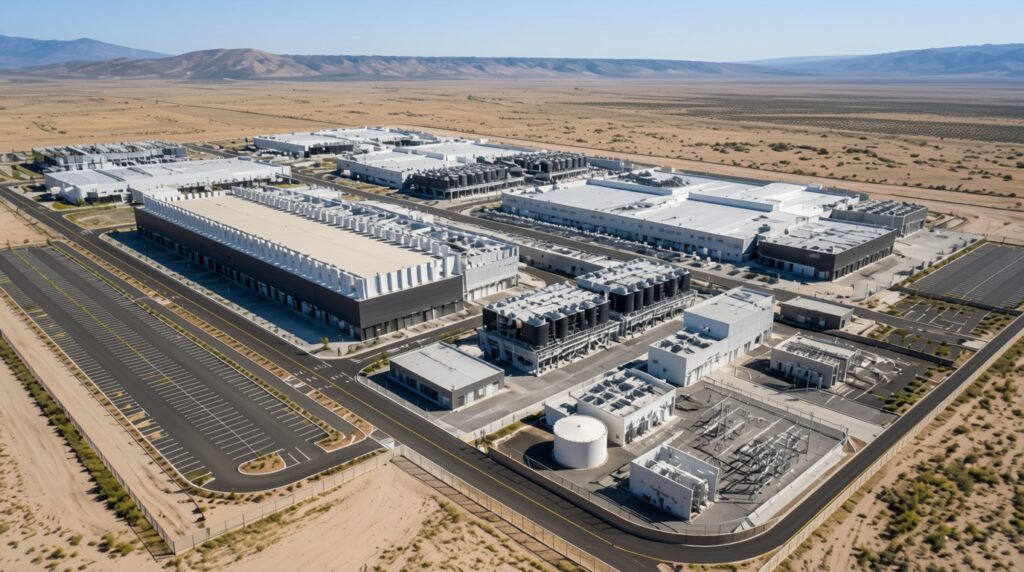
The Pros and Cons of Data Centers
Building new data centers, particularly those designed for artificial intelligence (AI), presents enormous economic opportunities but also significant challenges involving electricity, water, land use, environmental impacts, and local infrastructure.
The benefits and drawbacks depend heavily on where the data center is built, its size, the cooling technology employed, and how electricity and water are supplied.
One important distinction is that what is good for the data center developer is not necessarily good for the surrounding community.
1. Major advantages and disadvantages
| Advantages (Pros) | Disadvantages (Cons) |
|---|---|
| Economic development: Large capital investments in buildings, equipment, and infrastructure | High electricity demand: Large facilities can require hundreds of megawatts |
| Tax revenue: Increased property tax revenue for local governments | Water consumption: Evaporative cooling can consume substantial amounts of water |
| Construction employment: Hundreds or thousands of temporary jobs on large campuses | Limited permanent employment: Relatively few jobs after construction |
| Digital infrastructure: Supports AI, cloud computing, research, and business innovation | Utility costs: Grid upgrades and new infrastructure may increase costs for other customers |
| Infrastructure improvements: Potential investments in power lines, fiber networks, roads, and substations | Environmental impacts: Carbon emissions, diesel generators, noise, and land development |
| Business attraction: Can attract technology firms and specialized service providers | Land use conflicts: Large industrial facilities may compete with residential or agricultural development |
| Long-term investment: Facilities may operate for decades with continued reinvestment | Technology risks: Rapid changes in computing and cooling technologies can make equipment obsolete |
2. The three biggest challenges
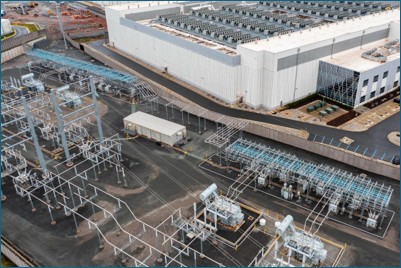
Electricity availability
A 100-megawatt data center operating continuously consumes approximately 876 million kWh annually. AI campuses can demand considerably more, potentially requiring new generation, substations, and transmission lines.
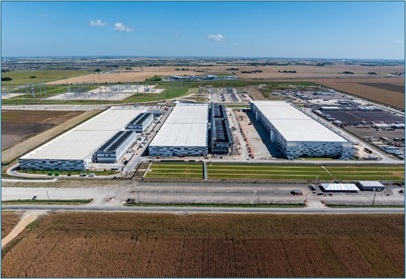
Water availability
Evaporative cooling systems can use hundreds of thousands or millions of gallons per day at large facilities, depending on design and operating conditions. Water availability, drought restrictions, and competing agricultural or municipal demand can complicate approvals.
Community and environmental concerns
Large campuses can occupy hundreds of acres, require extensive construction, and generate continuous equipment noise. Communities may question whether tax revenue and employment justify the infrastructure and environmental costs.
How quickly is the demand for data centers growing?
The International Energy Agency projects that worldwide data center electricity consumption will approximately double between 2025 and 2030, driven largely by AI.
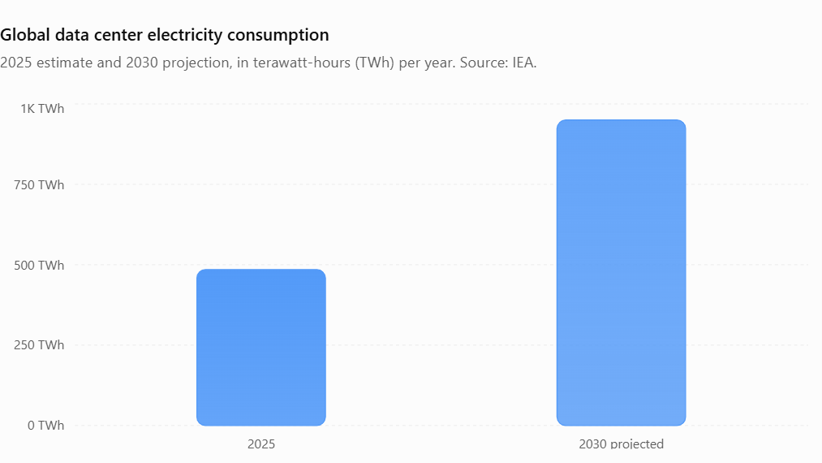
2025 estimate and 2030 projection, in terawatt-hours (TWh) per year. Source: IEA.
This growth creates opportunities for communities with available power, suitable land, reliable telecommunications, and sustainable water supplies.
How can new data centers reduce their disadvantages?
| Challenge | Potential solution |
|---|---|
| High water consumption | Direct-to-chip liquid cooling with dry coolers, closed-loop systems, and hybrid cooling |
| Limited municipal water | Reclaimed wastewater or appropriately tested groundwater |
| Electricity shortages | Dedicated generation, grid upgrades, energy storage, and flexible operations |
| Carbon emissions | Nuclear, renewable, geothermal, or other lower-emission power sources |
| Noise | Acoustic enclosures, equipment setbacks, and quieter cooling equipment |
| Community opposition | Transparent water and energy reporting, community benefit agreements, and developer-funded infrastructure |
One important qualification: Closed-loop cooling does not automatically mean zero water consumption. A closed liquid circuit can still reject heat through evaporative cooling towers. Dry coolers generally consume far less onsite water, but may require more electricity, particularly in hot weather.
The groundwater opportunity
For companies involved in groundwater exploration, there is another important dimension to data center development.
Water availability can influence site selection, project costs, regulatory approvals, and long-term operating reliability.
Groundwater exploration could help developers:
- Identify potential water-bearing formations before committing to a location.
- Evaluate sustainable well yields and groundwater quality.
- Reduce dependence on municipal drinking-water supplies where groundwater development is appropriate.
- Assess alternative water supplies for cooling and emergency requirements.
- Understand the risks of pumping interference, aquifer depletion, and future water restrictions.
AquaterreX, as a leader in locating previously untapped groundwater resources, can assist developers during early-stage site selection and water-resource evaluation, before substantial investments are made. Deep Seated Water should not be assumed to be renewable or available at a sustainable yield without supporting hydrogeological evidence.
When does a new data center make economic sense?
A proposed data center should be evaluated against five questions:
- Power: Can the developer obtain reliable electricity without imposing unreasonable costs on existing customers?
- Water: Is there a dependable, legally available supply that does not materially harm surrounding water users?
- Economics: Do tax revenues, local spending, and employment justify the public incentives and infrastructure costs?
- Environment: Can noise, emissions, water consumption, and other impacts be managed?
- Long-term viability: Can the facility adapt to changing AI technology and cooling requirements?
Overall Assessment
New data centers can be very beneficial to regional economies and national technological competitiveness. However, communities should be particularly careful about approving facilities that require major publicly funded electrical infrastructure or place additional stress on limited water resources.
The best developments are those where the developer bears an appropriate share of infrastructure costs, electricity is readily available, and water demand is quantified and sustainable.